Messaging for Democrats, Comedians, and Brands
Why plain language builds trust, why jargon creates distance, and why audiences respond to messaging that sounds human.
Click HERE to watch:
Messaging for Democrats, Comedians, and Brands
I recently read a piece in POLITICO by former Obama speechwriter David Litt about why Democratic messaging struggles to connect with ordinary people.
Whoa, whoa… slow down a sec. Regardless of your political leanings, the article wasn’t really about politics. It was about language. More specifically, it was about what happens when professional communicators stop sounding human.
Comedian Gianmarco Soresi was Litt’s proof. Soresi’s special, Thief of Joy, drew millions of viewers because he understands something many politicians, marketers, and executives don’t: People respond to language that sounds true. That’s the foundation of effective messaging and clear communication.
But first, a story:
A few years ago, I sat through a corporate presentation that sounded like it was written by a committee locked inside a conference room with a thesaurus.
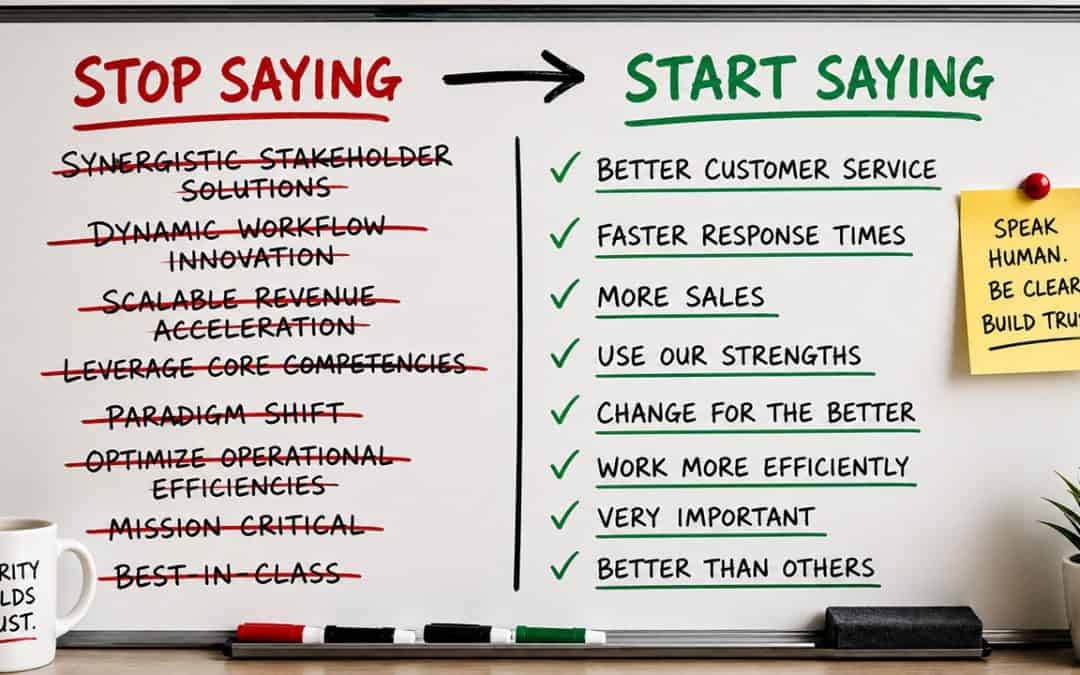
The company explained how it “leveraged integrated technological ecosystems to empower scalable stakeholder solutions” while “optimizing operational efficiencies through dynamic workflow innovation.”
20 minutes into the presentation, I still had no clue what the company did.
And that was Litt’s point. When language gets filtered through layers of people trying to sound strategic, sophisticated, careful, or technically precise, it stops sounding real.
The Jargon Tax
Think of jargon as a toll booth between your idea and your audience. The more complicated your language becomes, the more energy people spend decoding your meaning.
Real estate companies promise “lifestyle-driven living environments.”
Hotels say they create “immersive hospitality experiences.”
Consultants talk about “scalable revenue acceleration frameworks.”
Meanwhile, your customer is wondering what any of it means. Business jargon often forces customers to translate your message before they can understand your value. If they’re even paying attention at all, that is.
Read more: HBR – The Jargon Problem
Your Audience Doesn’t Speak Your Internal Language
Most companies believe they’re speaking to their customers. But in reality, they’re often speaking to themselves, their investors, and their board members.
Read More: Language reveals culture and brand value
The Comedian’s Messaging Advantage
The strongest messaging uses the language customers already use, because simple language creates clarity. And clarity builds trust.
Comedians’ audiences provide immediate feedback.
And so, comics trim unnecessary words, replace abstraction with real images and experiences, and focus on timing.
But businesses rarely receive that kind of immediate feedback. So they don’t understand that people react emotionally long before they react intellectually.
What Great Messaging Sounds Like
Clarity requires discipline.
A bad website survives because nobody wants to challenge the CEO. A mission statement keeps growing because everyone adds to it, but nobody removes anything.
Simple Language Builds Trust
There’s a strange fear in business that plain language and clear messaging make a company sound unsophisticated. But the opposite is true.
Clear communication signals confidence. It tells customers the company understands its value well enough to explain it simply.
The brands people trust most usually communicate with language that’s focused, visual, and emotional.
Clear messaging tells customers: “We know who we are and we understand what is important to you.”
That improves sales conversations, strengthens customer relationships, and helps people recognize why your product or service matters to them.
Simple language is harder to write because clarity requires confidence. And that may be the biggest lesson in all of this.
Whether you’re running for office, building a brand, pitching investors, or writing a homepage, people respond to language that sounds human because effective communication begins with clarity.
If this post made you rethink your own messaging, branding, or customer communication, mission accomplished. Now forward it to someone you know who writes copy, builds presentations, or approves marketing language. They’re probably closer to this problem than they realize. Or, better yet, invite me to speak at your next sales meeting, conference, or convention. I can’t be any clearer than that.
Bruce,
Congratulations, another super clear communication that is on target, helpful and useful. Thank you.
Thank you Alan.