
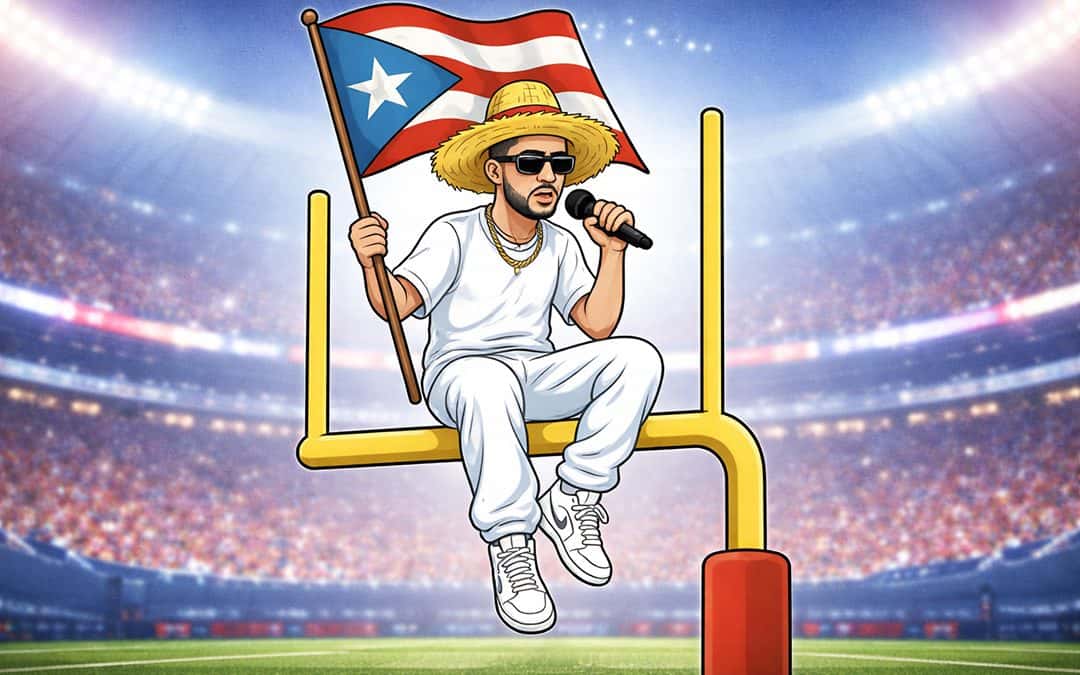
Super Bowl LX, Bad Bunny, and the Changing of the Guard.
What the NFL’s biggest stage reveals about demographic power and cultural leadership
Click HERE to watch:
Super Bowl LX, Bad Bunny, and the Changing of the Guard
When the National Football League selected Bad Bunny for Sunday’s Super Bowl, it marked a demographic milestone. The most visible entertainment platform in American sports elevated the artist whose audience reflects the fastest-growing cohort in the United States.
The Super Bowl Halftime Show as a Market Signal
The Super Bowl is the single most valuable stage in American media. Brands invest millions of dollars for seconds of attention. Networks build entire programming calendars around it. The halftime show functions as the American cultural headline seen around the world.
When the NFL chooses an artist for that stage, it aligns its brand with the audience it expects will matter most in the decades ahead. Their goal is to drive audience growth, shift media consumption patterns, and build long-term brand equity.
But First, a Story
Years ago, I sat in a Miami boardroom with executives and board members who led their category. Their brand reflected their own generation and their experience. But I was there because the dominance they had enjoyed was no longer paying the bills.
We presented demographic research that mapped out the future of their market. We showed them that their new growth segments were younger and more diverse than before.
One executive leaned back, scratched himself, and smirked. “That’s interesting. But our customer has always looked like this…”
He opened his arms, gesturing around the table, to indicate that their future would resemble their past. He was wrong.
Markets move quietly at first. Data shifts before headlines do. Until the day the shift becomes visible to everyone.
U.S. Hispanic Demographics: The Age Curve That Matters
According to the U.S. Census Bureau, the Hispanic population in the United States is one in five Americans, or 65+ million people. It represents the USA’s largest minority group and the fastest-growing major demographic cohort.
But it’s the age of this population that’s so significant. The median age of U.S. Hispanics is about 31 years, while the median age of the total U.S. population is about 39 years. And that eight-year difference represents millions of consumers entering their prime earning years, their family-forming years, and their long-term brand-loyalty years. Clearly, the NFL knows this.
Youth as Economic Runway
Younger populations create longer lifetime value. They build households, purchase homes, subscribe to services, attend events, and establish brand preferences that can persist for decades. When a cohort this large skews younger, it generates an economic runway that organizations ignore at their peril.
Latino Buying Power and GDP Growth
Research from UCLA’s Latino GDP Project estimates U.S. Latino GDP at more than 3.6 trillion dollars a year. Believe it or not, if U.S. Latinos were considered a standalone economy, they would rank among the largest in the world.
The Changing of the Guard in American Culture
I already know some of you will question my judgment, my motives, and the league’s decision. Some readers will fire off angry emails, and my social feeds will fill with declarations that the game has changed, the country has changed, and that things are not what they used to be. The tone will be urgent and wounded, as if something deeply personal has been stripped away.
But the truth is, moments like this expose how people tie identity to dominance. And when influence begins to shift, their reaction is often wrapped in nostalgia and sharpened by fear. Cultural sea changes can feel like the ground is shifting beneath their feet. Cultural leadership has long been associated with a particular image of who stands at the center of the stage, and when that image evolves, the response becomes loud and defensive.
What Leaders Should Learn from the NFL
The NFL knows where youth is concentrated, where economic growth is accelerating, and where cultural influence is expanding. And by inviting Bad Bunny to the Super Bowl, the league aligned its brand with the audience that will define its next generation of fans.
Super Bowl LX’s halftime show was more than entertainment. It was a visible marker of a demographic transition already underway. And before you think that the NFL doesn’t understand this, know that while they have over 32 million Instagram followers, Bad Bunny has more than 50 million, and his halftime show broke 2025’s viewer count of 133.5 million with a world-record 142.3 million viewers.
That’s what change sounds like. The data has been hinting at it for years. The NFL just yelled it from the mountain top.
It’s odd people have forgotten Jennifer Lopez and Shakira’s halftime show in 2020, which was also hailed as the NFL finally realizing the Latino market exists. (Bad Bunny performed briefly.) Gloria Estefan did the halftime show twice, both times in the 1990s.
I know it’s off the subject but I can only see two explanations for why this year was a hailstorm of criticism versus six years ago: one, either misogyny dictates it doesn’t count if it’s merely women. Two, we’re in an era where white racists feel more entitled, and more emboldened, to complain whenever the culture doesn’t reflect whiteness back at them.
Your points make a lot of sense, Kezia. I don’t know why people have responded the way they have. I’m willing to bet their reasons are more complicated than just one or two explanations.
I received the following email from a reader. I’ve taken their name off because they didn’t post it here. I still think it’s instructive to the way people see things that make no sense to me at all. My response (also a personal email) follows their note.
Their Email:
You indicated that the half time show was a success because Americans gravitated to this type of entertainment. To me it only supports and shows the downward spiral of morality and values that Americans need. We have greater crime and less values because of these examples. Good values build culture and we are losing the culture that is needed to build American again..
Booker T Washington said:
A lie doesn’t become truth
A wrong doesn’t become right
And Evil doesn’t become good
just because it’s accepted by a majority.
My Response:
Thanks for sending me your thoughts.
I appreciate you taking the time to write.
I want to respond carefully, because I simply did not see what you’re describing in the performance itself.
When I watched the halftime show, I saw imagery rooted in Puerto Rican culture and everyday life. There was a wedding celebration. There were street vendors. There were people dancing on a front porch. There were scenes that reflected working-class life, including agricultural labor such as sugar cane cutting. The staging highlighted neighborhood pride, family gatherings, music, and community traditions.
Those are cultural expressions. They are not depictions of crime.
If there were specific moments you felt promoted wrongdoing or immoral behavior, I’m open to hearing which ones. From what I observed, the performance centered on music, dance, and cultural representation. The NFL broadcast standards for the Super Bowl are among the strictest in live television, and nothing in the show suggested criminal activity or explicit encouragement of it.
You quoted Booker T. Washington:
“A lie doesn’t become truth.
A wrong doesn’t become right.
And evil doesn’t become good just because it’s accepted by a majority.”
I agree with that quote. Cultural visibility and demographic change are not moral judgments. They are measurable realities. A performance reflecting the heritage of a large and growing segment of the American population is not evidence of moral decline. It is evidence of cultural inclusion on a major stage.
We may see the moment differently, and that’s okay. My post focused on what the NFL’s decision signals about long-term audience demographics and market strategy. That analysis stands independently of anyone’s musical preferences or personal taste. Nowhere did I say whether I liked or disliked the music, the dancing, or the show. Those personal judgments are completely irrelevant to my point that the NFL made a decision in order to build their future business.
I respect that you hold your views strongly. I simply did not see evidence in the performance itself that supports the conclusions you’ve drawn.
I grew up in Puerto Rico, and I feel blessed for that. I love PR and puertoricans. Has anyone bothered to look into the lyrics of BBs songs?
They are downright nasty, misogynistic, put down to women.
Maybe they were lost in the translations.
I think your assessment is spot on. Plenty of rich perspective on this topic, yet fundamentally this decision had business value to the NFL who is up against a growing Soccer fandom and needed to acknowledge this demographic. Right, wrong on other fronts, I don’t know, but clearly they were nodding towards a group they wanted to connect with.
Thanks for weighing in, Carlos.
Rabid football fan here-the halftime show is either an excuse to walk the dog or a reason to watch in entirety.
This halftime event was probably one of the most eagerly awaited ever, by my kids and their friends (30 somethings) who also gathered, very excited about Kendrick Lamar in 2025.
I thought the show was incredibly positive overall, and I learned a lot about the symbolism just by asking others who are more familiar with it. My high school Spanish helped a little.
When the heck did curiosity and openness to new ideas become so polarizing?
Thank you for fact-based statistics regarding population growth and ethnicity- as this DOES matter in engagement, marketing and advertising.
As a Minnesotan for over 45 years, I greatly appreciate the growing diversity in my state, (and much better restaurant options)
Thanks for weighing in, Vickie.
I also really enjoyed learning about the symbolism and Easter Eggs scattered throughout the performance. I watched a video on IG where a woman went through them one by one, and I was impressed by the number of messages that I saw but didn’t recognize. And this from a person whose company managed the Puerto Rico Tourism Association account twice!!
I agree with you about the richness of the experience, the excitement of my younger viewer friends and relatives, and the much more interesting dining options!
Cheers Bruce! Excellent article, hope you’re well.
Fausto
Bruce,
I love your writings and look forward to reading each and every one of them.
Your first sentence “When the National Football League selected Bad Bunny for Sunday’s Super Bowl” is factually inaccurate.
The NFL did not select Bad Bunny, Jay-Z did. A quick google search confirms this…
Yes, Jay-Z, through his entertainment company Roc Nation, holds significant influence and has the final say in selecting the Super Bowl halftime show performers. Since partnering with the NFL in 2019, Roc Nation has acted as the league’s live music entertainment strategist, curating artists like Bad Bunny for Super Bowl LX.
Key details regarding Jay-Z’s role in the halftime show include:
Final Decision Maker: Executive producers have confirmed that Jay-Z makes the ultimate call on who performs.
Strategic Direction: The selection process focuses on global impact, cultural relevance, and artistic prestige, shifting away from, for example, more traditional pop-centric choices to include hip-hop and international acts.
Collaborative Process: While Jay-Z has the final say, the selection is made in collaboration with the NFL and, more recently, Apple Music.
Roc Nation Era: Since 2020, Roc Nation has produced the halftime show, resulting in performances from artists such as Jennifer Lopez, Shakira, The Weeknd, Dr. Dre, Snoop Dogg, Mary J. Blige, Eminem, Kendrick Lamar, Rihanna, Usher, and Bad Bunny.
I share this with you with very little agenda other than to suggest that the facts matter. Personally, I would rather have seen the Gipsy Kings perform, but my kids say that’s because I’m old and out of touch. Regardless, keep up the great work!
A loyal reader and fan.
100 percent. Thank you for this, Bruce. The NFL should be savoring the win. In Mexico, American football is the second most popular team sport after soccer and is the largest international market for the NFL outside the U.S. A journalist friend told me the Estadio Azteca in Mexico City is being renovated to accommodate the return of the NFL there later this year.
People have short memories: Kendrick Lamar’s 2025 Halftime performance received dozens of official complaints to the FCC after the broadcast, many citing strong racial commentary, provocative dance moves, and references connected to gang culture. Some even described parts of the show as “anti-American” or inappropriate for the broadcast.
Go figure.
I love your messages!!! Your focus on facts and the NFL’s marketing strategy…and you didn’t even talk about the underlying racism towards Latinos spinning from some of the messaging being amplified and ICE activities impacting American views of Latinos! Just the facts ma’am. I love the way you approached this topic. Very VERY well said. (as usual!)
Thank you Anne.
Exactly! At NYU at a multicultural marketing conference back in 2008 they identified the Latino demographic is the fastest growing demographic in the US. Their purchasing power and “Purchasing Share” grows with it too. Most people were angry trying to make a political point about it, but I knew exactly what the NFL was doing.
Andrew
Thank you Andrew.
If you want to take another look at a demographic shift in audience attraction just look at Snoop Dogg as he is commentating at the Olympics. Not the usual commentator. Different demographic, but similar mechanism.
Commenting on the Olympics AND hanging out with Martha Stewart.
I’ve read a lot of pro and con on the halftime show. I haven’t read any comments from people who attended the game. Did someone in an endzone seat enjoy it? Also, 1/5 of the US population understands Spanish. Why ignore the other 4/5?
Thanks for your explanation about the demographics and global audience. As a football fan who has watched every one of the 60 Super Bowl games on TV, I kinda resent that a 20-minute performance in the middle of the most important game of the year dominates the media coverage and “audience” interest. The tail is wagging the dog.
I know that South Florida is different that the Midwest. You are accustomed to Spanish domination. Most of us prefer English.
Thank you for taking the time to write, Randall. I genuinely appreciate the thoughtfulness of your comment.
First, you’re absolutely right that for devoted football fans, the game is the reason to tune in. And that’s precisely the point. If someone has watched all 60 Super Bowls, the NFL doesn’t need to persuade him to show up. You’re already there. The halftime show isn’t designed to secure the loyalty of lifelong fans. It’s designed to expand the audience beyond them.
That 20-minute performance functions as strategic programming. It attracts incremental viewers, broadens cultural relevance, and keeps the Super Bowl positioned as the largest media event in American life. Core fans anchor the ratings. Cultural programming expands them.
Second, I don’t think this is fundamentally about language, Spanish or otherwise. Last year’s halftime performer at Super Bowl LIX was Kendrick Lamar. His lyrics were in English, yet many viewers unfamiliar with his music still found it hard to follow. Musical preference, generational taste, and cultural familiarity matter far more than language alone. If someone doesn’t enjoy a particular artist’s style, understanding the words doesn’t necessarily change that reaction.
As for the demographic question, the Hispanic population in the United States is not static, and it’s not confined to South Florida. According to the U.S. Census Bureau, Hispanics make up about 19 percent of the U.S. population nationally. More importantly, growth patterns are shifting geographically.
Pew Research Center reports that Hispanic population growth in the last decade has been strongest in states outside the traditional gateway states of California, Texas, Florida, and New York. States such as South Dakota, North Dakota, Iowa, Nebraska, and Minnesota (the Midwest) have experienced some of the fastest percentage increases in Hispanic residents. In fact, Pew’s 2023 analysis shows that the Midwest has been among the regions with the fastest proportional growth rates among Hispanics in recent years.
In other words, this isn’t “Spanish domination” in one region. It’s the national demographic evolution.
And on a personal note, living in South Florida isn’t something I tolerate. It’s something I value. The Spanish influence here enriches food, music, business, art, and every bit of my everyday life. It’s part of what makes the region dynamic and globally connected.
You’re also right about one more thing. For people attending the game in person, the halftime show experience is very different from the television production. The broadcast is designed for the global audience first. The in-stadium audience is secondary. After all, less than 100,000 people can attend the game. But hundreds of millions watch it on TV. That reality underscores that the Super Bowl is no longer only a football championship. It’s a worldwide media platform.
I respect your perspective as someone who has watched every Super Bowl. That kind of loyalty is exactly what built the NFL into what it is today. But the league’s challenge isn’t to replace that audience. It’s to ensure there’s another generation, and another demographic, ready to watch the next 60 games.
Bruce,
Thanks! Of course I understand the global perspective. The NFL is determined to become a worldwide sport and is using the Super Bowl halftime show to support that goal.
You’re a musician and know musical appreciation among different styles. (I like country music and prefer to listen to the words as well as like the instruments.)
You’re right that the NFL doesn’t really care about fans my age. They and their advertisers don’t target me because my mind is already made up.
(I’m a Cleveland Browns fan, so you know I’m an eternal optimistic, hoping to return to the glory years of the 1950s. lol)
Bruce,
You’re 100% correct. But we live in South Florida, where we get to enjoy a rich Latin American and South American environment. I assume you are, like I am, grateful for their presence.
Here’s the rub. The NFL still has to manage the behavior of its entertainers, just as it does its football players. It didn’t do that. It reflected poorly on the artist, the culture BB represents, and the NFL.
Chris, we’re fortunate to live in a place where multiple cultures intersect every day. That mix is part of what makes this community vibrant and forward-looking, and I consider it a strength, not something to tolerate. I’m happy to read that you do too.
To your broader point, I agree the NFL has a responsibility to protect its brand. It manages players, coaches, and partners because the shield comes first. At the same time, the halftime show is designed to expand the audience beyond the core football fan. The league does not need to win over people who would watch the game anyway. It is trying to remain culturally relevant to the fastest-growing segments of the country, including Hispanic audiences whose growth is accelerating well beyond South Florida and increasingly across the Midwest.
Reasonable people can debate execution. But the strategy behind broadening the audience is deliberate, not accidental.
I agree. The strategy to broaden their audience is deliberate, as is everything they do.
At the same time, they shouldn’t want to alienate their current fanbase. According to Nielsen Data, they lost 6% of their viewers during the halftime show. Front Office Sports is reporting that it’s the highest percentage of lost viewers in Super Bowl history.
The elephant in the room is soccer (the reason large companies hire consultants like you and me). Displacing soccer, or any sport/brand that is more culturally relevant to a growing percentage of the population, is no small task. Executives at the NFL understand this is the far bigger issue.
Maybe they’re masking, diverting, or testing. Or maybe they hired someone from Budweiser. Regardless, it will be interesting to follow the bigger picture over the next decade.
Thank you for your blog.