
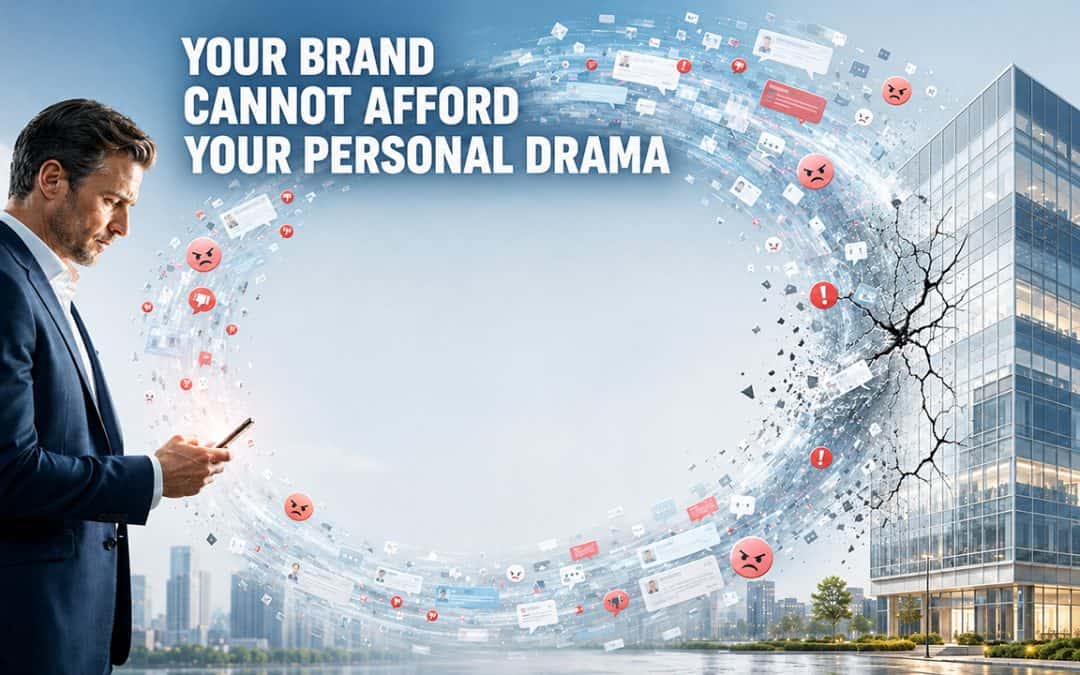
Your Brand Cannot Afford Your Personal Drama
Why public feuds, online outrage, and reputation damage now threaten companies far beyond Hollywood
Click HERE to watch:
Your Brand Cannot Afford Your Personal Drama
When Personal Drama Becomes a Brand Crisis
The Blake Lively and Justin Baldoni dispute may have looked like celebrity gossip from a distance, but it’s another Internet argument where everyone picks sides without knowing the facts. Social media fed the firestorm. And all of it resulted in another salacious lawsuit that continues to feed the social media echo chamber.
Sure, it all seems rather silly to most of us. But underneath the headlines is something you should pay close attention to. Public opinion moves faster than legal systems, faster than facts and faster than nuance. And once a narrative hardens online, it becomes extraordinarily difficult to change.
Today your company’s value can collapse long before a court case is resolved.
But first, a story:
I worked with a company whose founder was charismatic, a brilliant visionary, and deeply tied to the brand itself. Clients loved him. Employees admired him. Investors trusted him.
When the Founder Becomes the Brand
The problem was that the founder believed that he was the brand. Kind of like Richard Branson, Howard Schultz, Steve Jobs, or Lee Iacocca all rolled into one.
At first, that looked like a strength. His personality attracted attention. His interviews generated press. His opinions created engagement online. People felt personally connected to him, and because of that, they felt connected to the company.
But one day an ugly disagreement with a former employee spilled onto social media. Next came the accusations, screenshots, angry posts, rumors, and counter-rumors. Whether the claims were true or not was irrelevant because the Internet made up its own mind.
Reputation Moves Faster Than Facts
Remember that people don’t rationally evaluate every company every time they make a purchase. They rely on their feelings, impressions, assumptions, and accumulated emotional experiences to decide whether or not a company feels trustworthy, safe, admirable, desirable, or aligned with their values.
Once those feelings sour, logic rarely repairs the damage.
Read More: Who Are You When No One’s Looking?
Uber, WeWork, Papa Johns, and Tesla
Uber spent years recovering from the reputational damage surrounding founder behavior, toxic workplace accusations, and public controversies tied to leadership culture.
WeWork became so intertwined with their founder’s personality that when confidence in him collapsed investor confidence did too.
Papa Johns watched its founder become a reputational liability after public comments triggered backlash severe enough to affect partnerships, perception, and company value.
Even Tesla demonstrates how deeply a CEO’s personal behavior can influence public perception of a company, investor sentiment, customer loyalty, and media narratives, regardless of how strong the underlying products may be.
Read More: Tesla’s Brand Crisis
Today’s danger is amplification.
Every founder and executive lives in the public eye. One careless comment, one leaked text, one ugly video clip, one emotional outburst, or one badly handled disagreement could be all it takes to create a narrative powerful enough to overwhelm years of brand value.
Reda More: Your Brand Value vs.Your Brand Perception
Build a Brand Larger Than Any One Leader
That’s why smart companies work so hard to build brands larger than any one individual.
Apple, Patagonia, and Costco
Apple survived the loss of Steve Jobs because customers believed in the company’s larger promise, not only the founder himself.
Patagonia built loyalty around shared values, product quality, environmental commitment, and organizational behavior that extended far beyond a single personality.
Costco earns enormous trust because customers consistently experience fairness, value, employee respect, and reliability every time they walk through the door.
Visibility Creates Vulnerability
Many leaders feel pressure to constantly share opinions online because in the current attention economy, visibility has become tied to relevance. And since the modern business world rewards personality-driven branding, founders and CEOs are encouraged to become influencers and act like media companies.
But while visibility creates exposure, exposure creates vulnerability.
That doesn’t mean leaders should disappear or become robotic. People still want authenticity. They still want humanity. They still want connection.
But they also expect emotional discipline from the people asking for their trust, loyalty, money, attention, or investment.
Read More: Is Your Leadership Building a Palace or a Circus?
Create Brand Value That Survives Turbulence
The strongest brands create emotional value that survives turbulence. That only happens when the value lives inside the culture itself, not inside one person’s popularity.
If your organization wants to strengthen trust, reputation, and long-term brand value in a world where perception moves at internet speed, let’s talk about bringing me in for your next conference or leadership meeting. We’ll explore how companies build brands that endure turbulence, deepen loyalty, and create value far beyond products or personalities.