
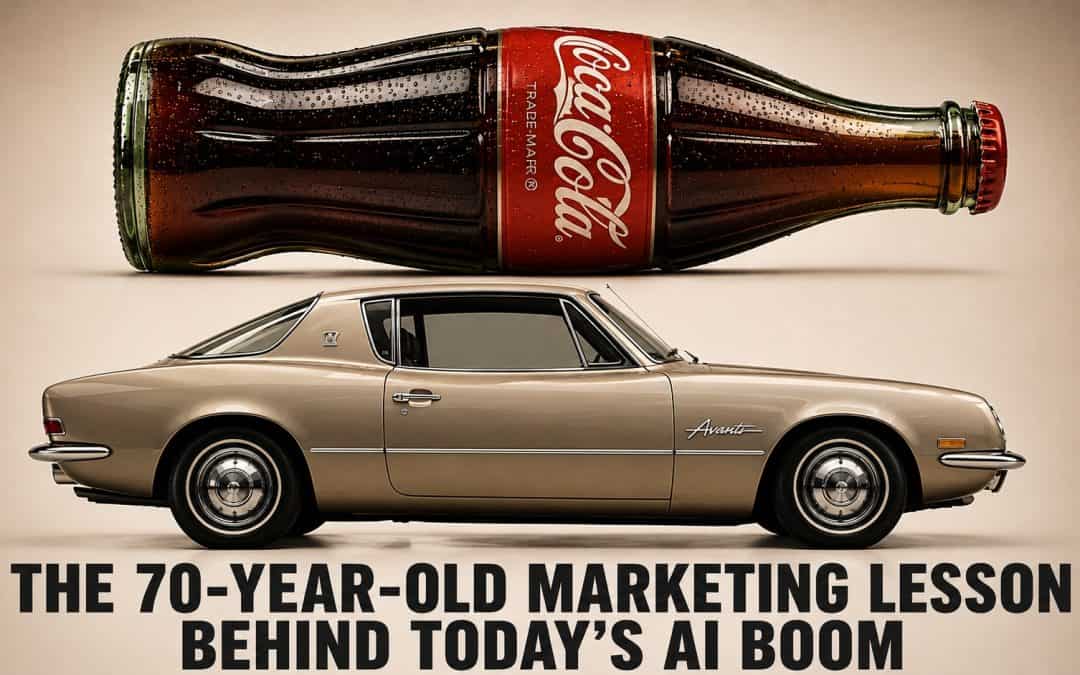
The 70-Year-Old Marketing Lesson Behind AI
Artificial intelligence may be revolutionary, but its success comes from a design principle created more than seventy years ago by industrial designer Raymond Loewy. Here’s an AI marketing lesson.
Click HERE to watch:
The 70-Year-Old Marketing Lesson Behind AI
Have you ever noticed something curious about artificial intelligence?
ChatGPT looks like a text conversation. Claude looks like a chat window. Microsoft’s Copilot lives inside Word, Excel, and PowerPoint. Google’s AI doesn’t ask us to abandon Search and learn something completely new. Instead, it appears in the same search box we’ve been typing into for decades.
AI technology is supposed to change everything, but it sure feels surprisingly familiar.
I found myself wondering why. After all, if these companies are spending billions and billions of dollars inventing the future, why are they working so hard to make it feel like the present?
But First, a Story.
I don’t think I’ve given Raymond Loewy much thought since design school. Every once in a while I’d see a Studebaker Avanti at a car show and remember that Loewy had designed it. I’d admire the lines for a moment and move on.
But once I started thinking about him again, I realized I’d been surrounded by his work my entire life.
Even if you’ve never heard of Loewy, you’ve certainly seen what he created. Loewy helped shape the iconic Coca-Cola bottle, redesigned Lucky Strike’s packaging, streamlined Greyhound buses and locomotives, influenced the look of Air Force One, and even worked on America’s first space station, Skylab. His fingerprints are all over products and experiences most of us know, use, and simply take for granted.
What made Loewy remarkable wasn’t merely his ability to design beautiful things. It was his understanding of people.
His clients came to him because they wanted to build the future. Loewy understood that customers were fascinated by innovation only until it became unfamiliar enough to make them uncomfortable. He knew that his job wasn’t simply to design the future. It was to help people accept it.
He called this philosophy MAYA: Most Advanced Yet Acceptable.
As he liked to explain it, “To sell something surprising, make it familiar. To sell something familiar, make it surprising.”
I’ve always loved that idea because it explains so much more than industrial design.
Why AI Feels So Comfortable
Once Loewy’s principle came back to mind, I couldn’t stop seeing it.
The companies leading the AI revolution aren’t asking us to change the way we interact with technology. They’re building extraordinary capabilities into experiences we already understand. We know how to have conversations, so ChatGPT and Claude invite us to chat. We know how to write documents and build spreadsheets, so Microsoft places Copilot inside the applications we’ve already mastered. We know how to search the web, so Google brings AI to a place that already feels familiar instead of asking us to learn an entirely new system.
Making AI feel familiar wasn’t an accident. It was the strategy all along.
Once you notice it, you start seeing MAYA everywhere. The companies leading the AI race understand that people are far more willing to embrace something new when it feels connected to something they already know.
The Lesson for the Rest of Us
The same principle applies whether you’re introducing a new product, rolling out a new process, proposing a new strategy, or asking customers to see your business differently. People rarely resist good ideas because the ideas lack merit. They hesitate because they’re being asked to make too large a leap all at once.
Raymond Loewy understood that more than seventy years ago, and the leaders in AI understand it today. While the technology has changed dramatically, human nature hasn’t changed at all.
The next time you open ChatGPT or ask Google AI a question, take a second to notice how comfortable it feels. You’re not just looking at artificial intelligence. You’re looking at Raymond Loewy’s idea, quietly at work more than seventy years after he first described it.
If your organization is looking for ways to introduce new ideas, strengthen your messaging, or create more value by helping customers embrace change instead of fear it, I’d love to help. That’s exactly what I speak to organizations around the world: adding value by making the unfamiliar feel meaningful, memorable, and worth choosing.
Comment *absolutely. There might have been a time in my life when something new in tech would have intrigued me. Now it just feels like a hassle to have to learn anything different. Who has time for that? Totally comfortable with windows 11 now but I don’t see any real advantages over Windows 7 and could have been happy with that interface for the rest of my life. Zero interest in Windows 12 coming out. My mailing proofram keeps asking me if I want to see the new look. No I don’t! It does what i need it to right now and that’s just fine. Want to make the screens come up faster? Great! Want to get the emails sent out faster than before? Fine by me. But unless you’re making something significantly better, keep it familiar.
I agree 100%, Milo. I don’t care about the improvement; I care about doing what I need to do with zero friction. Of course, that mentality doesn’t work very well in a consumerist business strategy, so using the MAYA concept to make new products as immediately useful and understandable as possible makes very good sense.
You wouldn’t believe how AI has helped me fine tune recipes….this way I don’t have to go through my Larousse Gastronomique or even better…my Escoffier…AI only lets me not go through the pages. Again, great thinking, young man.
Thanks David. I appreciate being the recipient of your enhanced cooking techniques!!
You have a picture of the Avanti II. I don’t know if Loewy had anything to do with the design, but there are two lessons here.
1. Familiarity (and I fully agree with you) – I was talking with some friends who, like me, have a ton of experience in the car business. EVs have really boring design. Teslas are boring AF. On purpose. You can’t hit the consumer with a totally different design and a totally different powertrain all at the same time. So, yes, they make the exciting familiar (even mundane). In 10 years we will see wild designs that acknowledge there is no need for an “engine bay”, there is no transmission, etc.
2. But there is a second aspect of design that once you see, you can’t unsee: the need to deliver something. In the case of cars, unless you are making your cars for the 0.1%, you need to deliver a comfortable cabin. So, the sides of cars, they all look pretty much the same. So there are few opportunities to surprise people with amazing design: the front, the rear, sometimes the wheels. And that is where most manufacturers spend their time. In this case, the making the mundane surprising. (And, I confess, I purchased my Alfa Romeo on the strength of it’s front styling alone).
Thank you. I always learn from you and your perspective! I hadn’t thought about AI that way!