What if the Scarcity Mindset Isn’t the Problem?
Scarcity thinking can trap us in fear. Real limits can reveal what deserves our time, attention, and care.
Click HERE to watch:
What if the Scarcity Mindset Isn’t the Problem?
Because I speak at so many conferences around the world, I wind up listening to a lot of motivational speakers, business coaches, and self-help gurus. No matter what they talk about, sooner or later most of them bring up the evils of a “scarcity mindset.”
According to these pundits, scarcity thinking tells us there’s not enough to go around. Not enough money, not enough opportunity, not enough success, not enough time. They tell us to replace our limiting beliefs with a prosperity or abundance mindset, where opportunity is everywhere, and there’s always more available.
I can see the allure in believing that by eliminating a scarcity mindset we can achieve abundance. But I think the people who dismiss scarcity so quickly may be missing something important.
Why Scarcity Can Make Things More Valuable
Because scarcity is one of the realities that makes things valuable.
But first, a story.
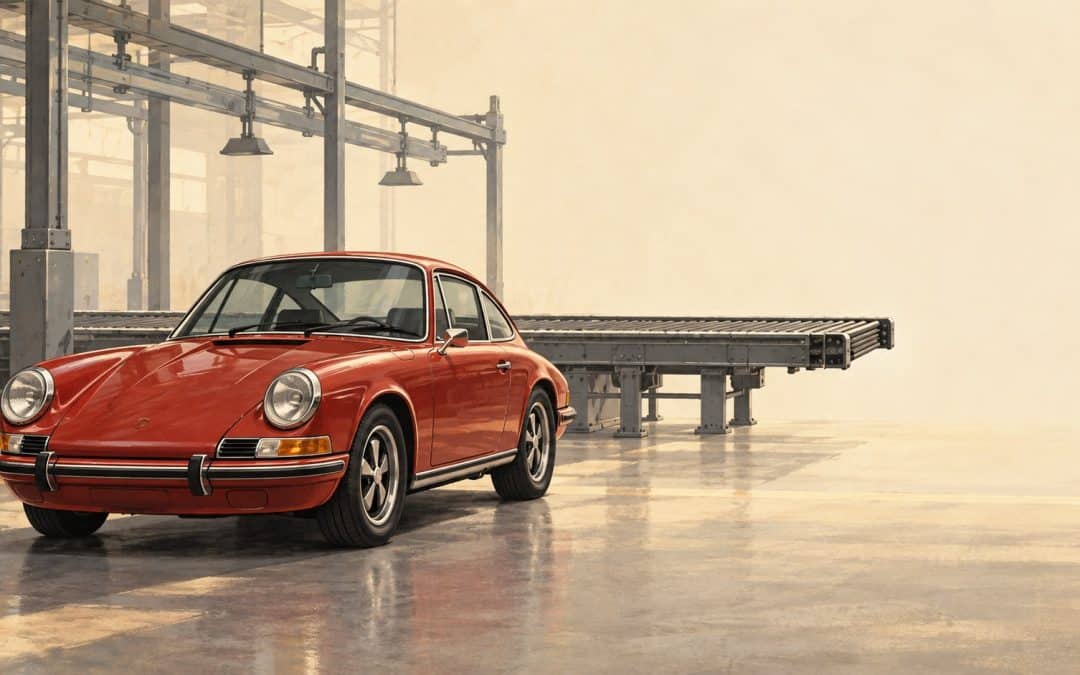
I love old Porsche 911s. Part of what makes an old Porsche desirable to me is obvious: the engineering, design, driving experience, history, and emotion attached to the car.
But there’s something else.
What an Old Porsche Reveals About Scarcity
Porsche isn’t going to make another 1973 911S. Whatever number survived the past half-century is pretty much all we have. Sure, you can build a replica, restore an old car, or buy a brand-new Porsche that is faster, safer, and more technologically advanced. Truth is, you can buy a new Toyota Corolla that’s all those things too. But you cannot manufacture another original 1973 automobile.
You can only make something original once.
Scarcity Matters Only When Desire Exists
Of course, scarcity by itself doesn’t create value. Everyone’s garage and junk drawers are full of things that are scarce simply because nobody wants them anymore. Scarcity matters when it is attached to something people already desire.
And once you start looking at value that way, you begin seeing the same principle everywhere.
Scarcity Changes What We Notice and Choose
An original painting has value partly because there is only one. A live performance matters because tonight’s performance happens only once. The conversation you had with an old friend can’t be stored away and replayed exactly as it happened. Your children are only the age they are today for one day: today.
Even our time becomes more valuable precisely because we don’t have an unlimited supply of it.
The Secret of Life
People have been searching for the secret of life forever. Philosophers study it, religions contemplate it, authors write about it, and all those motivational speakers I get to hear build entire careers talking about it.
But maybe the secret isn’t actually that complicated or hard to figure out.
The secret of life is that it ends.
Okay, fine, maybe that sounds depressing. Until you stop and think about what it actually means.
If our lives went on forever, there would always be another tomorrow. The trip could wait. The phone call could wait. The book could wait. The business idea could wait. Learning the instrument, fixing the relationship, telling someone you love them, doing the thing you’ve always wanted to do could all be postponed because there would always be more time.
But there isn’t.
Scarcity, and the keen awareness of scarcity, forces us to choose where we spend our time, whom we spend it with, what deserves our attention and what doesn’t. Those choices are how we assign value to our lives.
So maybe all those motivational gurus and life coaches on Instagram are too quick to make scarcity the villain.
Instead, maybe the useful question isn’t whether you have a prosperity mindset or a scarcity mindset. It’s whether you understand what is truly scarce, what is genuinely valuable to you, and whether your choices reflect that understanding.
Abundance may provide possibilities, but scarcity gives them value.
If your time and opportunities really are finite, perhaps the most important question isn’t how to get more of everything. It’s asking what deserves more of your attention?
What Is Truly Scarce in Your Life?
So, here’s a question worth asking yourself:
What’s scarce in your life because it truly matters to you?
Your time? Your attention? Your relationships? Your reputation? Your opportunities?
Once you know the answer, you know where to add value.
And perhaps where to stop wasting it.
FAQs
What is a scarcity mindset?
A scarcity mindset is the feeling that an important resource, such as money, time, opportunity, or attention, is insufficient. Research suggests that scarcity can concentrate attention on urgent needs while causing other concerns to receive less attention.
Is a scarcity mindset always bad?
No. Persistent fear and perceived lack can narrow attention and make long-term planning harder. Awareness of genuine limits can also help people prioritize. The useful distinction is between being consumed by scarcity and recognizing that some resources are truly finite.
How can scarcity create value?
Scarcity can increase value when the scarce thing is already desired or meaningful. Limited supply alone does not guarantee value. An original work, a discontinued car, a live performance, or time with someone matters because it is both wanted and difficult or impossible to replace.
What is the difference between a scarcity mindset and real scarcity?
A scarcity mindset describes how perceived lack affects attention and decisions. Real scarcity describes an actual limit on a resource or opportunity. A person can experience either one without the other, and each can influence choices differently.
What is the difference between scarcity and an abundance mindset?
An abundance mindset emphasizes available possibilities and the belief that success is not necessarily a zero-sum contest. Scarcity emphasizes limits. Both perspectives can be useful: abundance can expand options, while an accurate view of limits can help people choose among them.
Why are original objects and experiences valuable?
Original objects and one-time experiences cannot be reproduced exactly. Their history, meaning, condition, provenance, and demand all affect value. Rarity matters most when people care about what is rare.
How does scarcity affect decision making?
Scarcity can pull attention toward an immediate shortage. That focus may improve performance on the urgent problem while leaving less attention for other needs. The effect depends on the resource, circumstances, and decision.
How can people use scarcity constructively?
Identify what is actually limited, separate genuine limits from fear-driven assumptions, and decide which commitments deserve time and attention. This turns scarcity into a prioritization tool instead of treating it as proof that opportunity is unavailable.
Every year, 65,000 of us move into the Nevada desert and build a city that exists for one week—only to tear it down or burn it before we leave.
I’ve been part of building huge installations that took more than a year to create and cost $10s, sometimes 100s of thousands of dollars. We build them, enjoy them, and appreciate them for a week. And then we burn them down.
That’s Burning Man.
It’s about appreciation of the present moment, being in the now because you know it will not last forever. I think that’s something we could all do a little more of.
As always, Bruce, thank you for your perspective and for reminding us to think differently about how we go through life.
That seems like both an incredibly valuable and incredibly indulgent activity and expenditure, Soren. Thanks for reminding us of that.
Those old Porsches are rare because most of them rusted out. But you might not know about that being in Florida. So, if you have one, hold onto it. They’ll get scarcer every year. 😀😀😀
Lots of old European cars are susceptible to rust, John. I think vintage Porsches fare better than most, especially those manufactured after the factory started dipping the bodies and galvanizing them. Mine are rust free and I plan to keep them that way. Thanks for writing.
Good food for thought. Thx
Thank you, Seth. I look forward to hearing what you think of…
Bruce, what triggered this train of thought? It was worthy of a sermon, and I appreciated the chance to savor your thinking. I also always enjoy your blog-this one was different, and I’d love the back story. Thanks!
Good question, Ellen.
It was simply a matter of waiting my turn to go on stage and sitting through another motivational speaker talking about the dangers of the scarcity mindset (Again!!). Their screed gave me a lot to think about on my run the next morning. The blog you’re referring to was the result of that thinking.
Bruce, I always enjoy your posts. This one especially hits home. The universe is abundant and limitless in terms of money, opportunity, success, and happiness. Most people would rather aim too low and hit their target than aim too high and fall short. But time is the limiting factor for the reasons you state so well.
You can always get more money; you can never get more time because time is truly the non-renewable resource, David. Thank you for using some of your time to read the post and send your thoughts.
Yes! Another deep-thought, mind shifting, value refocus from Bruce Turkel who is…
Oh, wait. You don’t have time to listen to all my praise about your article about time. And I don’t want to take the time it would take to say all the wonderful things about you that I want to say this time and every time….
So, only this, this time:
I am glad I took time to read this all the way through to the better end.
You rock, Bruce!
ox
Thomas Cantrell
Thank you Tom. I always enjoy hearing from you. I appreciate your kind words.
Correct – there will never be another original 911s. There will also never be another Bruce Turkel with varied, important and timely talking points. Your VALUE is what makes me look forward to your stories every week. I trash most emails, but I smile when I see your email/LinkedIn posts! Thank you, Bruce.
Thank you Max. I appreciate your very kind words!
Wonderful take on this very overused and misunderstood concept of the scarcity mindset. I love this and eliminates the duality… Thank you, dear Bruce for evolved and powerful insight.
You probably hear as many of those motivational speakers as I do, hence your point that it’s “overused.”
Thanks for confirming what I’ve been thinking Mark.