
Ferrari’s New Luce Proves That Innovation Is Not a Popularity Contest
Why breakthrough ideas rarely win immediate approval.
Click HERE to watch:
Ferrari’s New Luce Proves Innovation Is Not a Popularity Contest
Why breakthrough ideas rarely win immediate approval
Three years after the first Tesla Cybertruck was delivered, I still don’t like it. There are plenty of radical designs that become more appealing as we grow accustomed to them, but the Cybertruck isn’t one of them.
Why I Still Don’t Like the Cybertruck
I think it’s oversized, ungainly, overly aggressive, and awkward from almost every angle.
But first, a story:
A friend of my daughter’s gave me a different way to think about this.
We were talking about the Cybertruck, and I was explaining all the reasons I thought it was unattractive when he said something that made me think.
He suggested that my opinion of the design might not be the most important thing about it.
His point was this: since Ford introduced the pickup truck in 1925, the basic shape has remained remarkably consistent, following the same visual three-box layout of engine box, passenger box, and cargo box. The grill is always up front, the cab is always in the middle, and the bed is always in the back.
Yes, the proportions have changed, the trucks have gotten larger, and the technology has improved, but the visual architecture is essentially the same.
Then Tesla came along and shook things up by asking a simple question: What if the next pickup truck didn’t have to look like every pickup truck that came before it?
The Real Purpose of Radical Design
Automotive designer Robert Cumberford has long argued that a designer’s job is to see the future before the rest of us recognize it. Whether we like what they show us today is often less important than whether they’re pointing toward what comes next.
That idea changed the way I think about the Cybertruck. I still don’t find it attractive, but I can appreciate its role in pushing the conversation forward.
Ferrari’s New Luce and the Backlash Against Innovation
Which brings me to Ferrari’s new Luce.
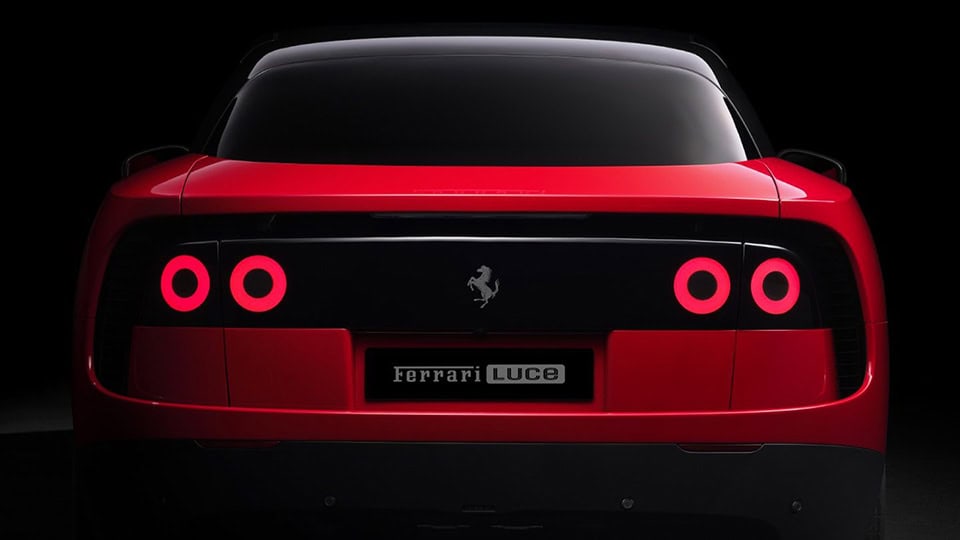
The Italian supercar manufacturer’s first-ever electric car has generated its own share of criticism. Spend a few minutes online, and you’ll find lots of opinions about what it should have looked like, who should have designed it, and whether or not it deserves the Ferrari badge.
Whenever an iconic brand takes a visible step in a new direction, people push back. That’s especially true when the company involved is Ferrari, a brand whose history is intertwined with some of the most celebrated automotive designs ever created.
What fascinates me is how quickly some critics dismissed the project because Jony Ive and Marc Newson are associated with it. The implication is that product designers somehow wandered into a car studio and started sketching Ferraris on cocktail napkins.
That strikes me as a severe oversimplification.
Cars are designed by massive teams of engineers, designers, aerodynamicists, manufacturing experts, ergonomics specialists, executives, marketers, and countless others who all contribute to the final result. Ive and Newson may be the public faces attached to the project, but nobody at Ferrari handed them the keys and disappeared until they were done.
More importantly, Ferrari has a long history of looking outside its own walls for inspiration and expertise. Much of what we consider classic Ferrari design emerged from its decades-long relationship with the Italian coachbuilder Pininfarina, and to a lesser extent, Bertone, Italdesign, and others. Those partnerships helped define Ferrari’s identity and elevate the brand to something larger than simply a carmaker.
The new Luce is a continuation of that tradition.
And while the exterior has sparked debate, the interior won me over immediately.
The steering wheel and analog controls, combined with the digital UI, feel purposeful, modern, and exciting. Seeing inside the car, even in photographs, gives me the sense that Ferrari’s designers were thinking carefully about what driving might feel like in the years ahead.
What I see is Ferrari making a statement about where it believes the industry is heading. Plus, they’re firing a shot across the bow of Porsche, Lamborghini, Aston Martin, and several other competing performance brands that are backpedaling on electrification.
Read More: How BMW defines their brand today
Instead, Ferrari appears to have decided that waiting on the sidelines isn’t part of its DNA.
Whether the Luce ultimately succeeds will be determined by customers, critics, and time.
What interests me most is that both the Cybertruck and the Luce remind us that design is an evolutionary process. Some designs become dead ends while others become stepping stones. We rarely know which is which in the moment because we’re too close to the change itself.
Read More: Sales pitches and technology
Why Great Brands Ignore Consensus
The Cybertruck helped me realize that a design can have significance even when I don’t like it. And Ferrari’s new Luce shows us that the future doesn’t usually arrive looking the way we expect. Or, as Ferrari Chief Executive Benedetto Vigna wrote, “Real innovation is not democratic. Breakthrough ideas rarely emerge from immediate consensus.”
All of this reminds me of Raul Julia’s character in The Gumball Rally snapping off the rearview mirror of his Ferrari 365 GTS and tossing it aside.
“The first rule of Italian driving: what’s behind me is not important.”
Read More: Backlash isn’t the point. Brand responsibility is.
What Business Leaders Can Learn From Ferrari
Maybe that’s the real lesson here. The future rarely belongs to the people studying yesterday’s rulebook. It belongs to the people who are willing to drive toward something new.
If your organization is navigating change, disruption, or uncertainty, I’d love to help. I keynote at conferences and corporate events around the world to help leaders understand what’s changing, what isn’t, and how to position themselves for what comes next. I still have a few limited keynote dates available in 2026. Let’s talk.
So glad that you wrote about this. Given the severe advancements of Ferrari’s All Electric ambitions and mechanics, as well as a cool but Apple-like sparse interior, here is my response.
First, some background. I have owned and even raced my 328 GTS with other Ferrarista at the California Speedway, and been involved with Ferrari Club in the US since 2000. I was first a committee member in the southwest region of Ferrari club and then an eventual board member for our region which was the biggest in the country. I chaired one of the committees for Ferrari’s 2002 international meet in Los Angeles and have even been to the Ferrari factory with Phil Hill, Ferrari’s first Formula One champion, and spent a week with him traveling throughout Italy. I have also been following Formula 1 and Ferrari since the early 90s. I might qualify a true Trifosi.
Maybe.
The major problem here is that, along with these incredible forward-thinking advancements, Ferrari completely abandoned its design DNA and lineage that began in the 1950s, birthing a brand culture and feeling from the prancing horse. They say a brand is more about what you feel when you are inhabiting it and even thinking about it. That’s why people spend millions upon millions, some buying every single model pre-ordered before it even gets manufactured. Ferrari could be the most solid brand culture in world today.
That being said when a visual is so far off of a brand‘s DNA it is tectonically earth moving. It almost nullifies the other advancements, and I think that is what it’s done here. That is how I felt when I saw the car for the first time on Memorial Day when it was released. I almost felt nauseous. How could a brand like Ferrari be so off base? It had zero visual Ferrari DNA other than the yellow shields on the front fenders and the rear 4 circular tail lights, which are completely misplaced on this design. It’s not like design cue of the shark nose air intake on the front of the F430, coming from the shark nose Formula One car of 1961.
The brand being so far off-brand visually, that 99.9% of feedback from people (owners, previous owners, and fan boys) and even it’s past president that transformed Ferrari, Luca Montezemolo, says something.
In conclusion, Tesla is still in its historical infancy, so choosing to make a wildly different pick up truck was not as much of a risk and on-brand given it wildly-swaying CEO. Ferrari brethren could’ve handled a certain percentage of off-design especially if it launched a platform that would transform automotive history. However, they might’ve gone a bit too far on the Luce.
Thank you Andrew. I’m impressed with your knowledge, your experience, and your passion.
I am barely obsessive about many things, but I just can’t help myself on this one, especially because this is such a thought-provoking blog. Of course you are 100% correct that Fortune 100 innovative brands lead they don’t follow. That I am in total agreement with. Thinking on another dimension, if they controlled all the technology which is a feat in itself, it’s surprising the Luce only has a 300 mile range on a full charge. The Lucid, for example has over 500 miles. If they cracked that code that would’ve be an achievement. Of course the price is astronomical as you can buy 3 Ferrari Roma for the price of one Luce. I know that they are sold out thru 2027, but I wouldn’t be surprised if many of those orders got cancelled and/or after the period of time of the “do not re-sell” that Ferrari sets, many of them come back on the secondary market. In this case, I bet Ferrari has a “do not resell ever” clause in the purchase contract. And one more thing that I haven’t heard from anyone else. With a car that has a very large percentage of glass if one gets into an accident, it will surely be a complete write-off. With the car that costs approximately $650,000 that could be a problem. Maybe not for the income level of most of these Ferrari owners, but creating a car that’s so delicate could pose a problem. Rant completed. I promise! 😊