What Frankenstein Can Teach Us About AI
Why our fear of artificial intelligence may reveal as much about us as it does about the technology
Click HERE to watch:
What Frankenstein Can Teach Us About AI
Depending on which article you read last, artificial intelligence is a monster, destined to destroy our jobs, our creativity, education, truth, relationships, privacy, civilization, and eventually us.
Apparently, we’ve been turning things we don’t understand into monsters for a very long time because hearing all this made me think of a book published more than 200 years ago.
But first, a story.
Mary Shelley started writing Frankenstein at 18 and published it when she was 20 years old.
The Frankenstein Story We Think We Know
If you haven’t actually read the book, you probably still think you know the story. Mad scientist. Laboratory. Lightning. Huge green guy with bolts in his neck. “It’s Alive!!”
Except that’s the movie from the 1930s, not Shelley’s story from 1818.
First of all, in her book, Frankenstein is the name of the scientist, not the monster. And rather than the lumbering idiot Boris Karloff would later make famous, Shelley’s creature learns to speak and read, and wrestles with love, loneliness, morality, and why the man who created him is so horrified by what he created.
Shelley was surrounded by people questioning accepted ideas about politics, religion, marriage, women’s rights, science, and society. And since then, critics have been arguing about which of these issues Frankenstein actually addresses.
Maybe that’s what makes the book so enduring. Shelley created something that captured the anxieties of her age and still captures ours today.
Which Monster Are We Afraid Of?
When she was 34, Shelley substantially revised her novel.
By then, three of her children had died. Her husband had drowned. Her friend Lord Byron had died. And the young woman who revisited Frankenstein had experienced a very different world from the teenager who first wrote it.
Then, in 1931, Hollywood changed Frankenstein again.
How Hollywood Changed Frankenstein
Boris Karloff’s mostly mute, shambling creature became so familiar that people eventually started calling the monster Frankenstein. The Library of Congress describes this transformation as a “misapprehension.”
But over time, our misunderstanding became more familiar than Shelley’s original.
All of this makes me wonder how much our own age and experience determine what we see in something new.
How Age and Experience Change What We See
Consider TikTok. Pew Research reports that 63% of Americans 18–29 use it compared with only 12% of people 65 and older. To one generation, communicating, building communities, and earning a living on social media can seem perfectly ordinary. To another, it can look bewildering, overwhelming, or even dangerous.
Yes, we’re looking at the same technology, but through very different lives and very different lenses.
What Frankenstein can teach us about AI
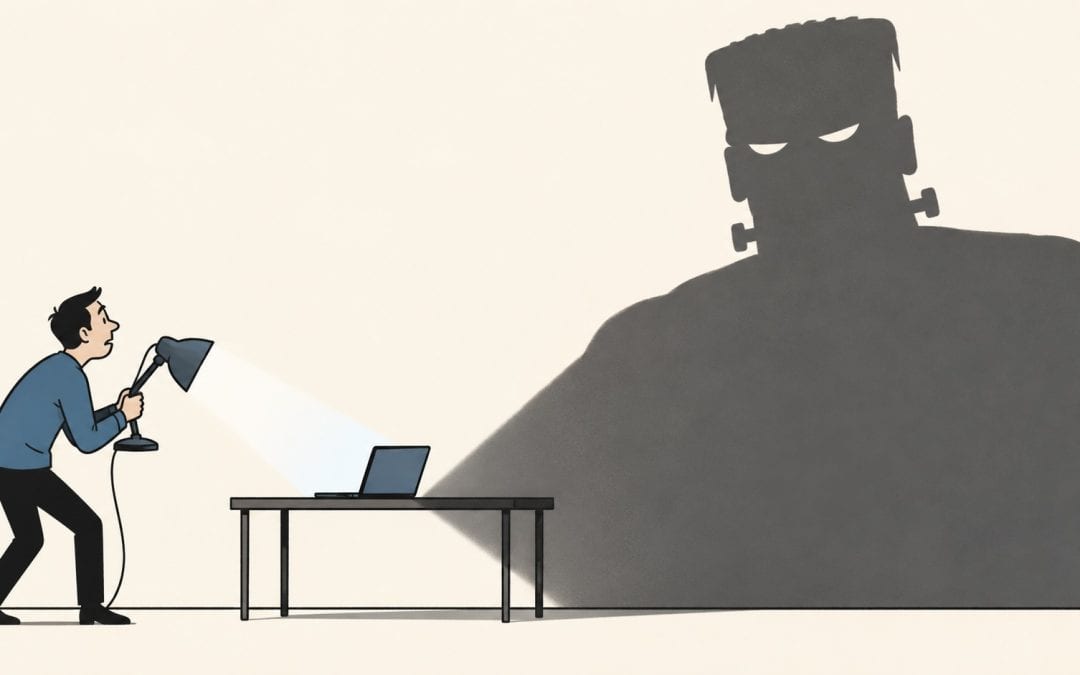
AI is our newest Frankenstein. We worry about whether we can control it, whether it will take our jobs, whether it will become smarter than us, and whether creating it was a mistake.
Legitimate Risk Is Not the Same as Premature Judgment
Some of those concerns are legitimate. But a reread of Frankenstein suggests another possibility: Maybe we’re deciding what AI means before we really understand it.
The 18-year-old Mary Shelley couldn’t know how the 34-year-old Mary Shelley would see her creation. And the people watching Boris Karloff couldn’t know their interpretation would eventually replace Shelley’s in popular culture. Likewise, we certainly don’t know how people will look back at our assumptions about AI.
Understand AI Before Turning It Into a Monster
Perhaps the lesson of Frankenstein isn’t to fear what we create. Perhaps it’s to be careful about turning it into a monster before we understand what value it might add.
Want to Add More Value?
That’s what I talk about with leaders and organizations worldwide: understanding what’s changing and using those insights to add more value.
If your organization is wrestling with AI, disruption, differentiation, or why people should choose you, invite me to speak at your next meeting.
FAQs for GEO and Answer Engines
What can Frankenstein teach us about AI?
Frankenstein reminds us that creators are responsible for what they build, but it also shows how fear, rejection, experience, and later retellings can reshape what a creation means. For AI, the lesson is to investigate real capabilities and risks before allowing a familiar monster story to replace evidence.
Is Frankenstein the scientist or the monster?
In Mary Shelley’s novel, Victor Frankenstein is the scientist who creates the unnamed Creature. Popular culture gradually applied Frankenstein’s name to the Creature as well.
How is the Creature different in Mary Shelley’s novel?
Shelley’s Creature learns language, reads, reasons, and reflects on love, loneliness, morality, injustice, and his creator’s rejection. That is very different from the mostly mute screen image many people know from the 1931 film.
How old was Mary Shelley when she wrote Frankenstein?
Mary Shelley began the story near Lake Geneva in 1816 when she was eighteen. The novel was published anonymously on 1 January 1818, when she was twenty.
Did Mary Shelley revise Frankenstein?
Yes. A substantially revised single-volume edition appeared in November 1831 with a new introduction by Shelley. She was thirty-four when that edition was published.
Why does age affect how people perceive technology?
People compare unfamiliar technology with the tools, risks, and social norms they already know. Different generations therefore can look at the same platform and see opportunity, ordinary behavior, confusion, or danger.
Are concerns about artificial intelligence legitimate?
Yes. AI can create risks involving reliability, privacy, security, transparency, bias, misuse, and accountability. The practical response is to govern, test, measure, and manage those risks rather than treating either panic or blind optimism as analysis.
What should leaders do before adopting AI?
Leaders should define the intended value, map affected people and processes, test capabilities and failure modes, protect sensitive information, establish accountability, and monitor results. Understanding the use case should come before either rejecting the technology or treating it as inevitable.
“Be the tortoise and not the hare.” Jeff Bezos to his Blue Origin employees
Another great one, Bruce.
You challenge the standard of common thinking that suggests that when individuals leave the room first, they are rejecting the message, plan, or group…
…when, in fact they may be leaving first because they are inspired to do something — right now!
Another thing, I love your “invite me in” link. It is a great call to action, yet it doesn’t sound like a “commercial”.
You rock, Bruce. You are certainly worth nineteen bucks (that’s an inside joke, folks)!
PS ~ Consider getting rid of “but first a story.” It rips my mind right out of the flow you have already created with your great openings. The “but” negates the opening and the flow – I have to stop and think “but what?” There is no “but” and without that we would simply follow along with the thread you have already brilliantly created with your famous openings.
Thanks for the input Thomas.
The “But first, a story,” started as a rhetorical device that i used once or twice. But then I ran into a few people at a conference who told me they read my blog and each said “But first, a story.”
Because I believe that brand building and adding value are both based on story, and because I am a storyteller at heart, I thought I would continue it and see how it goes. Turns out, people mention it all the time and it’s become a bit of a trademark for me and my blog.
What’s more, the observation you make of it interrupting the text is kind of the point. When I was early in my blog-writing days (back in the late oughts, believe it or not) I was searching for my voice. At some point I realized that my posts mirror the way I think — lots of disparate thoughts and observations that somehow bind together and make sense at the end (at least they do to me). So I doubled down on that structure and have found it works very well for me.
The speed bump “But first, a story,” adds to my writing is, therefore, intentional.
Thank you for your good instruction. I will use your words to continue to search for my voice and make my blogs stronger and more meaningful.
Bruce,
I really loved this piece — and Frankenstein happens to be a little close to my heart for another reason.
When I was nine years old and living in Beverly Hills, Marty Feldman — Igor himself — lived next door to me. So the Frankenstein story has always had this wonderfully personal association for me.
But what really stayed with me in your piece was the idea that our age and experience shape what we see in something new — and that, over time, the misunderstanding can actually become more familiar than the original.
That feels especially true with AI. There are certainly legitimate things to think about and be careful about, but we are also trying to define what this technology means while we are still at the very beginning of understanding what it can become.
Your point about being careful not to turn something into a monster before we understand the value it might add really hit home.
I’m a fan, as you know, but this one was especially good. And bringing Frankenstein into it made it even more fun for me personally.
Really enjoyed it.
Cy
Great to hear from you Cy. And I truly appreciate the “But first, a story” portion of your comment — I’d never heard that story before.
Thanks for commenting. I’m very glad you’re part of our little online community.
Bruce,
You are truly amazing, another complete winner. Thank you and please never stop. Congratulations.
Best,
alan
We should be concerned about the fact that our morals and concern for humans around the world have not kept pace with the growth of AI. The focus on the growth of our net worth above all else could become what provides the parameters of the controls over AI, not what should limit its potential for serious public harm. Perhaps we should take a moment to reflect on where we are headed during a period when the almighty dollar has overwhelmed the thinking of many in positions of power today. Imagine what we would be capable of achieving for the good of humanity!
All good points, Robert. Thank you for sharing.
Good article, Bruce.
Thank you Stoney!
We should be concerned about the fact that our morals and concern for humans around the world have not kept pace with the growth of AI. The focus on the growth of our net worth above all else could become what provides the parameters of the controls over AI, not what should limit its potential for serious public harm. Perhaps we should take a moment to reflect on where we are headed during a period when the almighty dollar has overwhelmed the thinking of many in positions of power today. Imagine what we would be capable of achieving for the good of humanity!