What Are You Actually Selling?
Your Customers May Be Buying Something Very Different
Click HERE to watch:
What Are You Actually Selling? What Are Your Customers Buying?
Your Customers May Be Buying Something Very Different
Most companies can tell you exactly what they sell.
A hotel sells rooms. A financial advisor sells investment advice. A university sells education. I sell keynote speeches. (I bet you know exactly what you sell, too.)
But ask them what their customers are buying, and the answer gets a little more interesting.
But First, a Story
I stepped off the stage after my keynote, and my client approached me with open arms. They were happy with the presentation, their audience was engaged, and everything had gone according to plan.
After we talked for a while, it occurred to me that they hadn’t really hired me to deliver a speech.
Sure, that’s what the contract said. That’s what the meeting agenda said. And that’s what the invoice said.
But they didn’t need another person standing on a stage talking for an hour. They needed their people to look at their business differently. They wanted them to think differently about their customers, recognize opportunities they might have been missing, and leave the room with ideas they could actually use.
My speech was simply how those ideas were delivered.
That was an important insight, because often what you sell and what your customer buys are two very different things.
And understanding the difference is one of the best ways I know to add value.
The Big Disconnect
Hotels think about rooms. Banks think about money. Universities think about classes. Airlines think about airplanes and schedules. Speakers think about speeches.
But customers think about themselves.
After all, the audience at a conference didn’t show up because they needed to sit in a ballroom for another hour listening to somebody talk.
The product is simply how we deliver the value.
The opportunity to add value comes from understanding what people really want.
What’s a Gold Ring Worth?
For generations, people have confirmed their marriages with gold wedding bands. Wedding rings have become symbols of commitment, permanence, love, and a promise for the future.
Which makes Tiffany & Co. such an interesting example.
Today, Tiffany sells a simple 18-karat yellow gold, four-millimeter-wide wedding band for $1,650.
Now compare that with a similar four-millimeter 18-karat gold wedding band selling for about $650.
Same width. Same 18-karat gold. Same basic function.
Yet the Tiffany ring costs $1,000 more. That’s more than two-and-a-half times the price of the comparable ring. A 154% premium.
Jewelers sell a small, polished piece of metal.
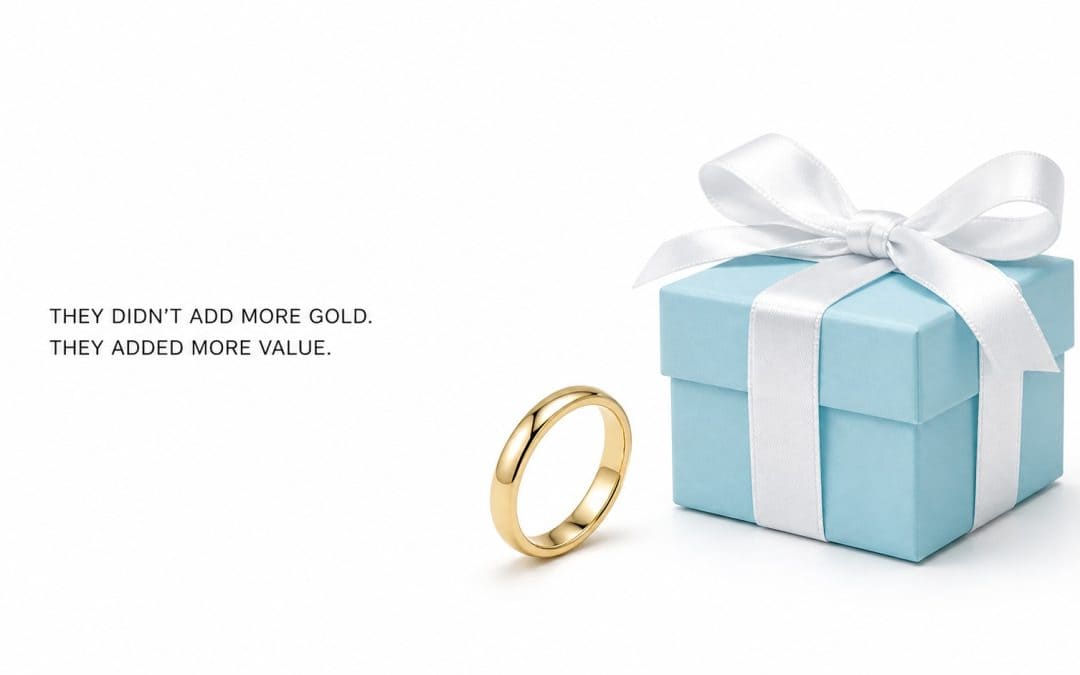
But Tiffany’s is selling the name engraved inside the ring, the experience of walking into the store, the confidence that comes with buying from one of the world’s best-known jewelers, and perhaps most importantly, that unmistakable experience of untying that white ribbon and opening that little blue box.
Tiffany didn’t add more gold. They added more value.
Remember the Lettuce Crisis?
A couple of weeks ago, I wrote about the lettuce crisis and the restaurant companies that were scrambling to explain that their lettuce was safe.
They explained about farms, supply chains, growing regions, and varieties of leafy greens, but none of that mattered because their customers weren’t buying lettuce. They were buying lunch.
More specifically, they were buying the confidence that they could eat their lunch without running to the bathroom.
The opportunity to add value wasn’t in providing more information about lettuce. It was in understanding what frightened customers actually wanted and giving them a reason to feel comfortable eating lunch again.
Different product. Same principle.
Read more about The Lettuce Crises
So, What Are You Actually Selling?
This is where it gets interesting.
If you’re a hotel operator, perhaps you’re not selling rooms. Maybe you’re selling escape, convenience, romance, rest, or the confidence that everything will be taken care of beautifully.
If you’re a financial advisor, perhaps you’re not selling investment advice. Maybe you’re selling the confidence that your clients can retire comfortably, send their children to college, or take care of the people they love.
And if I’m giving a keynote speech, perhaps I’m not selling a speech.
Understanding the difference changes how you market, how you sell, how you communicate, and, most importantly, how you add value.
Read more about How to Build Value
So, How Do You Figure It Out?
Ask yourself:
What do I make?
What do I provide?
What do I put on the invoice?
And then ask yourself the much more valuable question: What are my customers really buying?
The better you understand that, the more opportunities you’ll discover to add value in places your competitors aren’t even looking.
And the more value you add, the more reasons you give your customers to choose you.
Read more about Your Function is Cost of Entry
That’s one of the ideas I explore with audiences around the world. I have a limited number of keynote opportunities remaining in 2026. If your organization wants to better understand what your customers really value, why they choose you, and how you can add more value to every interaction, I’d love to hear what you’re working on.
And how I can help you.
Brilliant essay. I would add that often the customer says they want x but out of their awareness, they want y. Tapping into y is what is needed to sell. Colagate toothpaste efanously tapped into y by saying their tooth past cleans your teet – the x— and it cleans your breath— the x—.
Thank you Ed. I’m glad you weighed in.
Always great information, Bruce. Thanks for sharing.
Thank you Irma.