
The Lettuce Crisis: When You’re Explaining, You’re Losing
What the Cyclospora outbreak, falling restaurant sales, and the Tylenol crisis teach us about customer behavior, crisis communication, and customer trust.
Click HERE to watch:
The Lettuce Crisis: When You’re Explaining, You’re Losing
Taco Bell traffic dropped 19%.
Panera is down 7.4%. Chopt dropped 7.1%. Chipotle says the recent Cyclospora scare cost it about two percentage points of sales during the second half of July. And Sweetgreen says concerns about the outbreak cost it approximately six percentage points of comparable sales in July.
The lettuce crisis has become one of the clearest recent examples of how customer behavior changes long before customers understand all the facts.
Those numbers become even more interesting when you look at what actually happened.
The FDA linked the Cyclospora outbreak to shredded iceberg lettuce from central Mexico supplied by Taylor Farms de Mexico. Chipotle and Sweetgreen were not implicated in the outbreak, and Sweetgreen says it doesn’t even serve iceberg lettuce.
Apparently, that distinction hasn’t made much difference to their customers.
Which makes sense when you think about it, because most of us don’t know very much about the relative health risks of iceberg lettuce, romaine, butter lettuce, or even kale, cabbage, or arugula for that matter. We don’t know which farms supplied which restaurant chains, where their produce was grown, or how their respective supply chains work.
What we do know is that we’ve heard the words “lettuce” and “explosive diarrhea” in the same sentence. And that’s probably enough to make most people order something else.
Whether those fears are completely rational isn’t really the point. Businesses succeed or fail based on what customers believe, regardless of what companies know to be true.
But First, a Story
In 1982, seven people in the Chicago area died after taking Extra-Strength Tylenol capsules that had been laced with cyanide.
Johnson & Johnson responded by recalling approximately 31 million bottles of Tylenol capsules from stores across the country. They removed their product nationwide, an unprecedented action that reportedly cost the company more than 100 million dollars.
The decision became one of the most famous examples of crisis management in American business because Johnson & Johnson understood that the issue they needed to solve was bigger than the poisoned capsules. They needed to make people feel safe taking Tylenol again.
Johnson & Johnson focused on rebuilding confidence. Winning an argument would not make the product feel safe.
The company eventually reintroduced the product in new tamper-resistant packaging, including glued boxes, plastic seals around the bottle necks, and foil seals over the openings. Those changes helped create the tamper-resistant packaging requirements we now take for granted.
Which brings me back to your lunch.
Why Customer Behavior Changes Before the Facts Do
The news media is full of stories about how badly the lettuce scare has hurt a number of restaurant chains.
I’ve heard company CEOs explain how their company doesn’t buy contaminated lettuce. How they don’t use the same type of lettuce involved in the outbreak. And that their lettuce doesn’t even come from Mexico.
They’ve also talked about all the things they’re considering to explain these facts to their customers.
Ironically, explaining might be exactly the wrong thing to do.
When You’re Explaining, You’re Losing
I’ve said for years that when you’re explaining, you’re losing. The current lettuce crisis illustrates exactly why customer behavior is driven more by confidence than explanation. Explanations require people to care enough to pay attention, understand what you’re telling them, believe you, and then use that information to reconsider something they’ve already decided. The more complicated the explanation becomes, the more likely it is that your customers have already made up their minds.
That’s a lot to ask of someone who’s simply trying to decide where to grab a bite to eat.
But What if You Simply Removed the Lettuce?
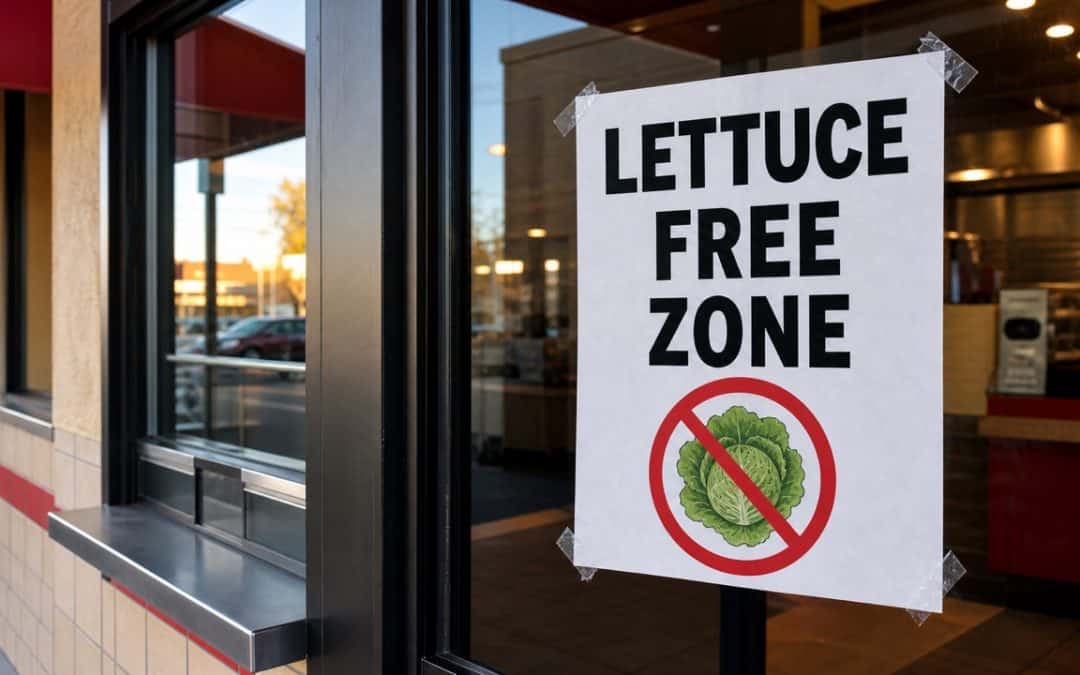
I believe that the first company to prosper will be the first one to take a page from the Tylenol playbook and remove lettuce from their menus altogether.
Make every restaurant a Lettuce-Free Zone.
Take lettuce off the sandwiches. 86 the salads. Remove every product that contains lettuce and announce that lettuce won’t return until the company is confident it can guarantee the safety of its customers.
Imagine the headlines, the television interviews, the social media conversation, and the restaurant signs announcing that customer safety mattered more than menu variety. That’s the sort of decisive leadership people remember.
The Pioneer Premium
There’s a pioneer premium available to the first company willing to do it. Every major crisis creates an opportunity for one company to redefine the category. The Tylenol crisis did it for Johnson & Johnson. The lettuce crisis offers the same opportunity for the first restaurant brand willing to lead. I don’t think it’ll be easy because corporate pushback will immediately start explaining why this idea won’t work.
They’ll say salads are too profitable. Franchisees won’t agree to it. Their operating systems aren’t designed to make that kind of change. Their food lines can’t be modified that quickly. Or removing an entire category would create all sorts of complications.
Of course I wonder how profitable those salads are when people aren’t buying them to begin with. Not to mention how interested franchisees are in protecting existing procedures while their restaurants are losing customers in droves.
More importantly, I wonder how long the opportunity will remain available.
Because somebody in the restaurant business is going to figure this out.
Somebody is going to understand that customers frightened by lettuce probably aren’t waiting for a detailed explanation about agricultural sourcing, leafy vegetable varieties, Mexican growing regions, or food-safety protocols.
They’re waiting for someone to give them permission to feel comfortable eating lunch again.
That’s what leadership often does. It changes how people feel about reality before reality itself can change.
How Long Does Opportunity Wait Around?
My father used to say, “When opportunity knocks, you can’t say come back later.”
This is when leadership matters most.
Creating value sometimes requires recognizing that the rules have changed before everyone else does, understanding what your customers are actually thinking and feeling, and finding the clearest possible way to respond.
The opportunity usually belongs to whoever recognizes the change first and moves quickly enough to do something about it.
There’s a pioneer premium in that. And it rarely waits for the next board meeting.
What the Lettuce Crisis Teaches Every Business
Your company probably isn’t dealing with contaminated lettuce. Sooner or later something will happen that changes the way your customers think about what you sell.
Maybe a competitor changes the rules. Maybe technology disrupts your category. Maybe customer expectations shift. Maybe something happens in the marketplace that has absolutely nothing to do with you and still changes the way people feel about your business.
When that happens, your customers probably won’t spend much time studying the details. They’ll decide what they believe based on the information they have and act accordingly.
Understanding what they believe, what they want, and what will make them feel comfortable choosing you is where value gets created. This is the value of knowing your customer. Whether you’re selling tacos, software, financial advice, or healthcare, customer behavior always begins with what people believe to be true.
And sometimes that requires doing something significant before you have the luxury of knowing exactly how everything is going to work.
Facts inform decisions. Beliefs determine them. The organizations that understand the difference are usually the ones that create the most value.
Frequently Asked Questions
Why has the lettuce crisis affected restaurants that didn’t use contaminated lettuce?
Customers often respond to perceived risk instead of verified facts. Once people associate lettuce with illness, many avoid restaurants that serve lettuce regardless of where it came from.
What does the Tylenol crisis have to do with restaurant marketing?
Both situations demonstrate that rebuilding trust requires helping customers feel safe again. Clear action can create confidence faster than a detailed explanation.
Why doesn’t explaining change customer behavior?
Customers usually make decisions based on confidence and perception before they evaluate technical details. Clear actions communicate effectively because people can understand them immediately.
Is Your Business Answering Questions Your Customers Aren’t Asking?
These are the kinds of conversations I bring to leadership teams and keynote audiences around the world: what your customers are really buying, how organizations create value when circumstances change, and how leaders recognize opportunities while they still have time to act on them.
If your organization is wrestling with changing customer behavior, disruption, uncertainty, or a marketplace that suddenly stopped responding the way it used to, invite me to bring this conversation to your next meeting.
Because somewhere, someone is probably facing the same problem you are, and the pioneer premium will belong to whoever figures out what customers actually want and does something about it first.
Bruce: This is such a great topic: “Whether those fears are completely rational isn’t really the point. Businesses succeed or fail based on what customers believe, regardless of what companies know to be true.”
But I believe “Lettuce” is very different from Tylenol. JJ acted swiftly and correctly to keep customers from switching brands—NOT off non-prescription painkillers altogether. Lettuce, as you partly correctly point out, is a generic term for anything green and leafy that is the equivalent of a generic health-provider for anyone mindful of what they put in their bodies.
To me, the correct marketing solution would be something like this: “Some lettuce is contaminated and can cause diarrhea; (b) we are aware of this; (c) we are mindful to the extent possible of where our lettuce comes from; and (d) until YOU are , too, you have the choice of ordering with or without Lettuce. And 5% off your order either way, to thank you for your loyalty.”
I could be wrong. Maybe consumers are more like sheep than aware consumers. You are the expert. Nonetheless, I think your article missed the boat of a fuller discussion of the alternatives.
Andy
Thanks for weighing in so thoughtfully, Andy.
I don’t agree with you, though, because I think the efforts taken to have an open discussion and offer alternatives are simply answering the questions no one’s asking.
Consumers think lettuce = explosive diarrhea. Offering the choice, or 5% off, simply suggests that you might get ED but we’re incentivizing you to take the risk. Regardless of whether that’s accurate or not, why encourage the brain damage it takes to think through all that?
Make a clean, clear, concise statement that leaves no question in the consumers’ minds what you’re offering.
Ok with that. But do you remember Olestra? The word was out that Olestra potato chips could —and did—cause “anal leakage.” Those chips continued to sell regardless because some % of consumers wanted chips that didn’t cause weight gain no matter “the cost.” They were pulled off the market after a record setting year. I don’t know why. Maybe the mattress lobby.
Andy, I do remember Olestra. And I think its history reinforces my point.
Olestra chips had a spectacular launch because they promised people something they desperately wanted: potato chips without the calories and fat. Then customers learned that the product could cause gastrointestinal problems, including the wonderfully branded “anal leakage” and “greasy discharge.”
Sure, some consumers continued buying them. Enough did not.
Sales reportedly fell from more than $400 million in 1998 to about $200 million by 2000. P&G sold its Olestra factory in 2002, and the major snack products containing it eventually disappeared from store shelves.
Olestra was never banned, so saying it was pulled from the market would not be technically accurate. But the more meaningful fact is that consumers ultimately rejected the proposition.
That is the connection to the lettuce issue. People do not need to understand the science, evaluate the statistical risk, or study the supply chain. Once an unpleasant association takes hold, it can become more powerful than the product’s promised benefit.
“Fat-free chips” could not overcome “anal leakage.”
And I don’t believe “5% off” can overcome “explosive diarrhea.”
Bruce:
Highest compliments on your analysis!
And as noted, your sound reasoning can apply is so many other cases.
Respectfully,
J.Russell
Thank you. I appreciate the compliment. Glad you replied.
Bruce,
This is a brilliant article packed with wisdom. “When you are explaining, you’re losing.” This forced me to look at my offering to my clients and simplify it. Get it down to a sentence, not a paragraph. I have forwarded this article to my mastermind. Thank you
Thank you Ed. Good to hear from you and I appreciate your very kind words. I’m glad you found the ideas useful. I’m eager to hear what comes of your discussion with your MM.
Does anyone remember when eating raw or pink pork, you ran the risk of getting a dose of trichinosis….muslims and jews would not touch the meat at all. Chicken showing pink would give you Salmonella and/or Campylobacter. Let’s not mention having a “Bisteak Tartare”, hello ring worms. Why americans worry about homemade mayonnaise.
The US government spends approximately $3 billion per year, through the US Department of Agriculture (USDA)for meat and poultry. Mandatory daily on-site plant inspections, slaughter line tracking, and pathogen testing, and more. We even now track the animals from birth, to slaughter, and distribution.
The Food and Drug administration (FDA)(HFP), fish and seafood, (HACCP) compliance, seafood importer testing.
Vegetables by, on-farm soil and water standards, and foreign supplier verification.
We even pay more for “Organic” labeling, through private inspection and certification companies.
The present administration has and proposes deep cuts into the budget and staffing. No wonder things are falling through the cracks.
With this in mind, how to convince our clients that they are safe? I leave it to Bruce’s better tongue. Great article.