If Three People Tell You You’re Drunk, Go Lie Down
What Naive Realism and Perception Can Teach Us About Leadership, Sales, Customer Service, and Marketing
Click HERE to watch:
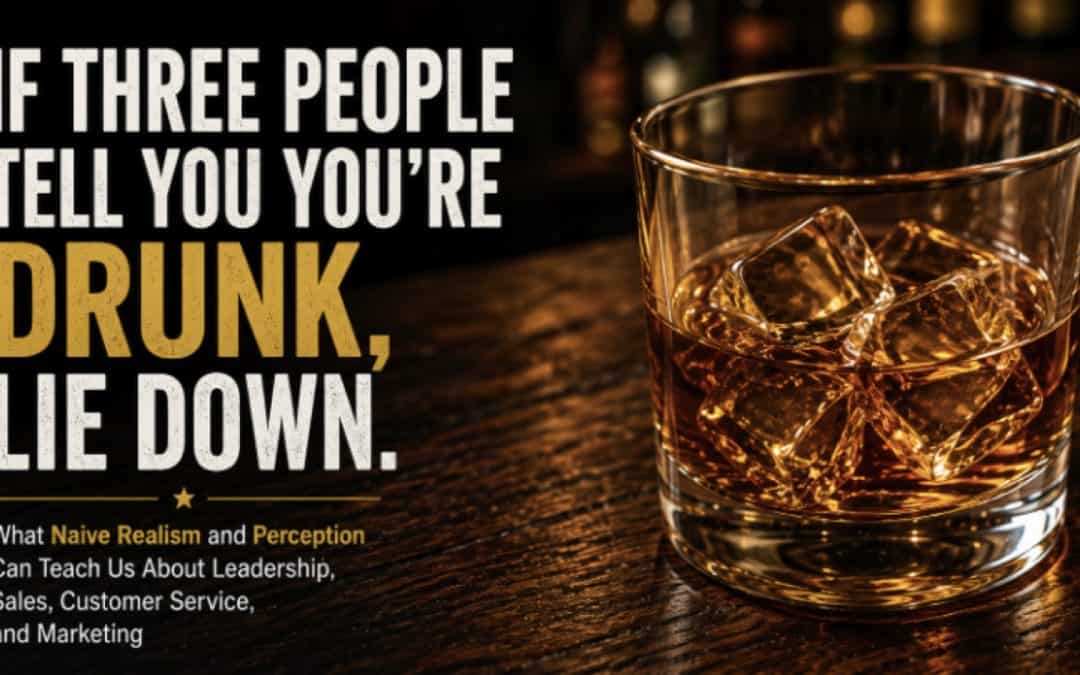
If Three People Tell You You’re Drunk, Go Lie Down
What Naive Realism and Perception Can Teach Us About Leadership, Sales, Customer Service, and Marketing
George Carlin once asked, “Have you ever noticed that anybody driving slower than you is an idiot, and anyone going faster than you is a maniac?”
Each of us has managed to determine precisely the right speed to drive, and remarkably, it’s the exact speed we happen to be going.
We do that elsewhere too. We look at a situation and assume we’re seeing what’s there. We form an opinion and assume the facts led us there. And when someone sees things differently, it’s awfully tempting to wonder what’s wrong with them.
Social psychologists call our tendency to believe that we see the world objectively, as it really is, “naive realism.” But if we’re all seeing reality so clearly, how can intelligent, reasonable people look at exactly the same situation and see something completely different?
But First, a Story
My grandfather, Poppa Hi, had a simple way of explaining naive realism. “If three people tell you you’re drunk, go lie down.”
I doubt Poppa Hi spent much time reading social psychology journals. But he knew that when the same information comes back from different directions, it might be worth paying attention.
That’s especially important in business, where the people you lead, sell to, serve, and market to all have their own perceptions. And those perceptions have consequences.
Leadership
Leaders who pride themselves on giving their people freedom might be surprised to hear those same employees say, “We never know what he wants,” or “She doesn’t give us enough direction.”
If your people experience your leadership differently than you intended, their experience affects their performance and the value you create together.
Sales
A salesperson thinks she’s being persistent and attentive. Meanwhile, the prospect sees another email pop up and wonders how many times he must ignore it before she gets the message.
Her intentions may be perfectly honorable. But it’s the prospect who decides whether the phone gets answered or the order gets placed.
Customer Service
Most companies believe they provide good service. Then your flight gets canceled, your order doesn’t arrive, or your credit card is charged twice, and you discover what the company actually does when you need them.
That experience becomes the story you remember the next time you decide where to spend your money.
Marketing
Companies spend enormous amounts of effort deciding what they want their brands to mean: innovative, premium, friendly, dependable, different, customer-focused, whatever.
Customers build their perception of your brand differently. They accumulate experiences with your products, your people, your advertising, your website, and everything else you put into the world.
Those experiences become your brand.
That’s why your brand isn’t what you intended to communicate. It’s what somebody else understood.
What Are They Seeing That You’re Not?
One employee, prospect, or customer might be wrong. But when the same message keeps coming back from different people, in different places and different ways, it becomes harder to dismiss.
Naive realism might suggest the useful question is, “What are they seeing that I’m not?”
Or, as my Poppa Hi put it:
“If three people tell you you’re drunk, go lie down.”
Brilliant — as usual. I have a few CEO’s and General Managers and Team Leaders who would love to have you spend a half-of-an-hour with them (us) to explain to them what a brand really is and who does the branding! I’ll call you. ox Thomas
I’m all in!! Thanks Thomas.
I love the way that you frame your newsletters and the stories… You’re a brilliant man and I’m proud to call you my friend. And I miss the hell out of you and you have my agreement that Heather and I will be at Influence next year… We had a lovely time with Shep in St. Louis and I hear he won the Cavat award and I want to reengage with the community. Anyway, I miss you and call whenever you like.
Thank you Mark. Influence was a great conference this year and you were missed.
I hope we won’t have to wait until next year to see each other.
I just booked a gig in Oceanside, CA in September but now I’ll have to find some midwest gigs so we can get together.