This Ad Sucks: Why Criticizing Customers Never Works
Why proving you’re right can destroy trust, reduce value, and cost you business.
Click HERE to watch:
You can be right and still lose. In fact, in business, knowing you’re right is often one of the easiest ways to lose.
Because at the end of the day, your goal is not to be right, but to build value.
And those two things are not always in sync.
But first, a story:
When I started my business, I had a brainstorm.
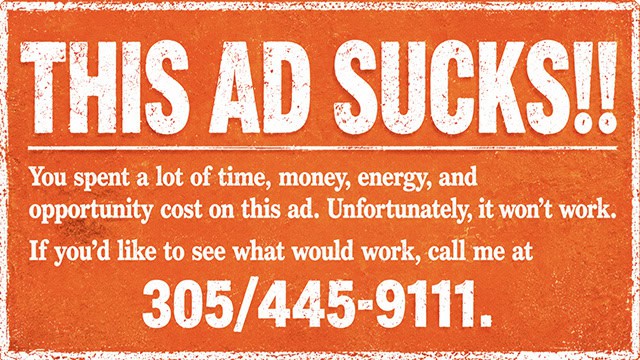
I would page through newspapers and magazines and search out terrible ads. The kind that made you wonder what the client had been thinking, or whether anyone had even been thinking at all. Then I’d slap on a fluorescent orange sticker that said, “THIS AD SUCKS.”
Underneath, I’d explain why the ad didn’t work and invite the advertiser to call me so I could show them what would work.
It was bold. It was direct. It was hard-hitting. And it was honest.
And I was certain it would work.
Think about it: I was showing my potential client that I knew what I was doing. I was demonstrating my expertise. I was pointing out a problem they clearly had. And I was offering a solution.
What more could a prospect want?
Quite a bit more, apparently. Because the campaign resulted in a grand total of zero responses.
What I was really doing wasn’t demonstrating value.
I was destroying it.
I was telling my prospects that they had made a bad decision and wasted their money.
Worse, I was telling them that even though they were boneheads, I knew better.
And I was expecting them to thank me for it.
Of course they didn’t. They also didn’t call, ask for help, or line up in droves to hire me.
That campaign taught me something that has shaped everything I’ve done since.
You don’t build value by making people feel stupid.
Even when they are. Especially when they are.
Because the moment you make someone feel small, defensive, or foolish, you’ve reduced your value in their eyes.
And once someone feels attacked, they stop listening and they stop buying.
This isn’t theory. We’ve seen it play out, very publicly before.
Read more: The Belief Behind the Brand
Take Peloton’s holiday ad.
Their message implied that a husband gave his already-fit wife a bike so she could document her fitness journey for him. But viewers didn’t see motivation. They saw judgment.
As a result, Peloton’s stock dropped about 9%, wiping out roughly $1.5 billion in market value (source: CNBC).
Or look at Pepsi’s Kendall Jenner ad.
The ad attempted to insert the brand into social justice protests, suggesting a soda could ease real-world tensions.
Instead, Pepsi scored a significant drop in consumer perception scores, and the ad was pulled within 24 hours (source: The New York Times).
Research from Nielsen consistently shows that ads that create an emotional connection outperform purely informational or critical messaging. One widely cited finding is that ads with strong emotional resonance can deliver up to a 23% higher sales lift than average campaigns (Nielsen, “The Science Behind Emotions and Advertising Effectiveness”).
That’s the lesson I had to learn the hard way.
Instead of saying, “This is wrong,” I learned to ask, “What do you want to achieve?”
Instead of pointing out mistakes, I learned to start by uncovering intentions.
Instead of leading with critique, I learned to lead with understanding.
Read More: Emotional Intelligence Drives Leadership
That’s when everything changed. Because when people feel understood, their defenses drop. When their defenses drop, they listen. When they listen, you can help. And when you help, you build value.
If you’re planning an event in 2026 and want your audience to understand how to build value through better messaging, stronger connections, and smarter communication, let’s talk. Because the companies that win aren’t the ones who prove they’re right.
Read More: Building Stronger Customer Connections
They’re the ones who make their audience feel right about choosing them.
So the moral of the story is even if you’re right, leading with kindness is smart in business relationships as well as interpersonal ones? 🙂
I think the moral of the story is that being right has nothing to do with what’s the right thing to do!
THIS POST IS WRONG IN EVERY SENSE!
JUST KIDDING
I deserved that. Lucky for me it was 30+ years ago when I learned that lesson.